

 Posts
Posts


A short story goes viral
>> Friday, 2 March 2012
Very thgt provoking..what seems like a fad today was the way to live...where did we go wrong :(

-----------
Checking out at the supermarket recently, the young cashier suggested I should bring my own bags because plastic bags weren’t good for the environment. I apologized and explained, “We didn’t have this green thing back in my earlier days“.
The clerk responded, “That’s our problem today. Your generation did not care enough to save our environment for future generations“.
She was right about one thing–our generation didn’t have the green thing in “Our” day. So what did we have back then? After some reflection and soul-searching on “Our” day, here’s what I remembered we did have….
Back then, we returned milk bottles, pop bottles and beer bottles to the store. The store sent them back to the plant to be washed and sterilized and refilled, so it could use the same bottles repeatedly. So they really were recycled. But we didn’t have the green thing back in our day.
We walked up stairs, because we didn’t have an escalator in every store and office building. We walked to the grocery store and didn’t climb into a 300-horsepower machine every time we had to go two blocks. But she was right. We didn’t have the green thing in our day.
Back then, we washed the baby’s nappies because we didn’t have the throw-away kind. We dried clothes on a line, not in an energy gobbling machine burning up 240 volts — wind and solar power really did dry our clothes back in our early days. Kids got hand-me-down clothes from their brothers or sisters, not always brand-new clothing. But that young lady is right. We didn’t have the green thing back in our day.
Back then, we had one TV, or radio, in the house — not a TV in every room. And the TV had a small screen the size of a handkerchief (remember them?), not a screen the size of Wales. In the kitchen, we blended & stirred by hand because we didn’t have electric machines to do everything for us. When we packaged a fragile item to send in the mail, we used wadded up old newspapers to cushion it, not Styrofoam or plastic bubble wrap.
Back then, we didn’t fire up an engine and burn petrol just to cut the lawn. We used a push mower that ran on human power. We exercised by working so we didn’t need to go to a health club to run on treadmills that operate on electricity. But she’s right. We didn’t have the green thing back then.
We drank from a water fountain when we were thirsty instead of using a cup or a plastic bottle every time we had a drink of water. We refilled writing pens with ink instead of buying a new pen, and we replaced the razor blades in a razor instead of throwing away the whole razor just because the blade got dull. But we didn’t have the green thing back then.
Back then, people took the bus, and kids rode their bikes to school or walked instead of turning their mums into a 24-hour taxi service. We had one electrical outlet in a room, not an entire bank of sockets to power a dozen appliances. And we didn’t need a computerized gadget to receive a signal beamed from satellites 2,000 miles out in space in order to find the nearest pizza joint.
But isn’t it sad the current generation laments how wasteful we old folks were just because we didn’t have the green thing back then?

Read more...
Creating awareness ~ in style
>> Saturday, 11 February 2012

(click on the pic for a larger version)
source: linkThis amazing picture is a view of the swimming pool at Bhakti Par in Mumbai, India. The eye-catching
swimming pool has been built to raise awareness about the threat of sea level rises as a result of global warming. It was constructed by attaching a giant aerial photograph of the New York City skyline to the floor of the pool.
Conceived by: Ogilvy & Mather
Commissioned by: HSBC to promote its £50million project tackling climate change.
How they did it
O&G team used an aerial shot of a city to the base of a swimming pool.The pool gives a shocking view of a city submerged in water. A sunken city view was to drive home the impact of global warming, and how it could destroy our world someday soon.
What better way to create awareness about rising sea levels and the imapct of global warming. Melting glaciers and north pole issues are not only a threat to polar bears but will take us down too Read more...
Cookies Anyone
>> Thursday, 19 January 2012
Going to the grocery store with my DH means getting home atleast one pack of cookies/biscuits. Frequency has reduced over the years, however I intend to put a complete stop to it. Being a no kids home - its easy for us. And we dont need all that high fructose corn syrup, preservatives, colours, processed sugar and maida/all purpose flour either. I bake a lot so the solution - bake whenever he wants to buy a pack.
Apart from dietary no-nos, what troubles me is all the packaging it brings along.

note to self!:
- I need to follow Beth Terry's idea to write more frequently to companies and totally give up on buying them
- bake my whole wheat eggless versions at home
Please share your thgts on this..would love to hear if you ever think of this, and if you did, your solutions Read more...
Guest Post ~ Second To None ~ Anu Gummaraju's green initiative :)
>> Monday, 16 January 2012
I am glad I met Anu Gummaraju on the blogosphere. A genuinely warm lady who blogs over at scatter the batter and A fleeting Glimpse. Her blogs being one of the reasons for my admiration, another is her initiative in Banglore - An initiative called Second to None. (I had the privilege of doing one of the initial posts for the blog :). India has very few flea markets worth mention. More about the initiative and the flea market in Anu's own words :)
------
Armchair enviornment-activism is all very good, but there comes a time in all our lives, I presume, when it just isn't enough. We may be thinking constantly of how much plastic the world is generating and consuming and discarding in dangerous ways, we see signs to keep our city clean and think yes! I will do it, we know we have to conserve water and electricity and do a little bit in that direction in our homes. But is that all?
This became a big, big question for me around mid last year. It wasn't enough. Could there be some way of first, practicing and then nudging the change on a broader scale? Prodded by this, I was looking for avenues in Bangalore by which reuse and recycling could be promoted.There were a few fora for giving away unused goods, but they were voluntary and not very wide spread. Craig's list was just too anonymous and scam-ridden too, at times. There was no physical space for such activity, apart from the really old Bangalore markets which are very congested today!
The Market
Flea markets have always been a favourite concept of mine, and the idea of a local market in Bangalore, which could serve as a promoter of recycling and conservation and at the same time, provide a fun atmosphere for people to congregate and exchange ideas and learn about going green, suddenly appealed big time.
Speaking to friends and fellow passionate green-people, Reena Chengappa and Shilpa Kamath, about the idea, their enthusiasm and willingness to be a part of this movement sealed it. And Second to None was kicked off in June 2011.

We started first with an online group (an online flea market of sorts), on Facebook, to provide a platform for people in the city to interact and exchange reuse ideas and to buy and sell used goods online. A group with people who either knew each other or were added by friends seemed to be a reliable platform. The online group took off, with members selling anything from curtains to post and pans, to furniture, and exchanging reuse ideas. At the same time, we were also planning the first physical flea market, and scouting for an ideal location, a space which would support and nurture such an initiative and Jaaga (which means Space in Kannada) lent itself brilliantly to the cause. Read about Jaaga here (http://www.jaaga.in/).

With Jaaga booked for July of 2011, we were all set to kick off the flea market experiment over two days of a weekend. The only publicity we had at the this time was the Facebook group network and two local news dailies who figured this was new enough in Bangalore to be talked about. And what a fun weekend that was! The two days of the market came quite abuzz with activity, where like minded folk came together to buy and sell used goods from their homes, gardens, and more. We had resourceful members well versed in waste management, composting at home, effort-free drip gardening, and so on talking to visitors and helping them start similar ventures on their own. We had sellers exhibiting papier mache lamps, paper bead jewellery, recycled paper products, knick knacks from homes, decor, books, movies and more. And everyone wanted more.

So the flea markets have become a regular event now, we had one more market in Nov 2011, and the 3rd market is happening in Feb 2012. Between markets, the Facebook group has grown to 1260+ members and everyone is sharing and talking about how we can make simple changes in our daily lives, which can cumulatively make a big impact.

The idea of a local market, which happens regularly, is what I think appeals to people and encourages thinking and participation. It has provided a fillip for people to come participate and be a very physical part of the reuse concept, making us believe that local groups, events and happenings is the way to go to spread the word and get people involved. And the involvement here isn't just with the facilitators (us and Jaaga). It is everyone who comes in to sell or buy.

The sellers make the space what it is, it is they who can make an event exciting and spread the word. When each one of them gives away, sells or makes new things out of old stuff, they are sending out a message. A message that says old does not mean useless, that we can use objects for more than their perceived shelf lives, that the more we reuse the less garbage we burden the earth with. Such a place is also a great place for bargains.

Let us face it, everyone is aspirational and there will always be people who want to own the next best thing, even in plastic, if they have not had it before. And what better than to get it at a good price? So the market has seen some barely used and vintage stuff going at incredible prices, which makes both buyer and seller happy.

Second to None began with a core principal of consuming less and reusing more, and making healthy choices for ourselves and for the planet. But we did not start with a blueprint, we have grown and learnt and accommodated new ideas along the way. We support home kitchens making organic food, and NGOs who empower people with training to earn a lving. Their products get exhibited and sold at the markets.
What is most exciting for us is that people from across the cHide allountry have joined the group and have started similar ventures in their own cities, citing Second to None as their inspiration. We are so happy about that! There is Reduse in Hyderabad, by Ipshita Roychowdhury and Rashmi, The Best and The Rest in Ahmedabad by Saurabh Pacheriwala and Anushree Poddar (https://www.facebook.com/groups/225422360867287/), BombayB by Joanna Lobo and Yoshita Sengupta (https://www.facebook.com/groups/BombayB/).
As we set up the 3rd market in Feb 2012, we are seeing so much enthusiasm and sincerity in people who really want to make an effort in reusing and recycling. Everything under the sun that has a use and a purpose is being sold online and at the markets today, and here are just some of the repurpose ideas shared by the group:
Painting, decorating used bulbs as decor items or plant hangers.
Bags from denim pants.
Fashioning anything from bangle stands to soft boards with salvaged wood pieces.
Runners, table cloths and more from wasted pieces of fabric from tailors.
Candle holders with used bulbs.
Waste toilet seats refashioned into mirror frames, pieces of art.
Etching and art on used wine bottles.
Jewellery and accessories with used buttons.
Old photographs, prints from magazines into wall art.
Decoupage old boxes and containers with used newspaper, other prints.
Bags, pouches and more made from tetra pack paper, jute rice bags, etc.
Side tables with cable spools.

The list is quite long and growing every day! Check into the FB page or blog to stay updated on all the cool ideas that are out there!
Thank you Sudha, for asking me to write in A Green Crusader @ Work. Many of your posts on the environment and green choices are inspirational!
===
Thank you Anu...people like you give me hope and will to continue what I do :) Read more...
New beginnings for the better at University of California
>> Wednesday, 11 January 2012
I got this message in my email and had to share it here.
For Immediate Release:
Student groups at the University of California Santa Barbara, including the Associated Students Coastal Fund, Environmental Affairs Board, Isla Vista Surfrider Foundation and CalPirg, have banded together with campus administration and the Plastic Pollution Coalition to make a profound impact on the campus community and the City of Santa Barbara.
Compelled by the goal to ban single use plastic bags and raise awareness of the detrimental affects of plastics on our environment, the students have created a new partnership on campus named the UCSB-Plastic Pollution Coalition (UCSB-PPC).
The global Plastic Pollution Coalition (PPC) is an alliance of individuals, organizations and businesses working together to stop plastic pollution and reduce its toxic impacts on humans,animals and the environment. The UCSB-PPC is participating in the global PPC's "Plastic-Free Campuses" project as the pilot school. The goal of the project is to encourage more universities to reduce their plastic consumption by educating their fellow students, raising awareness in the campus community and actively engaging students in campus policy.
Alyssa Hall, a core member of the UCSB-PPC, described the importance of the campaign that "We live in one of the most exceptional places in the world. We go to one of the most exceptional schools in the world. Shouldn't our policies around single use plastic be exceptional as well? We can do better than single use plastics and the UCSB - Plastic Pollution Coalition has unified our campus around eliminating this wasteful practice."
The week of January 9 - January 13 marks the kickoff of the campaign and will include such displays as dumping a single days worth of plastic collected in the center of campus, the installation of a sculpture made completely of plastic found on local beaches, and a press conference.
In conjunction with UCSB-PPC's campaign, UCSB Reads, which hands out over 3,000 free books to students every year, has chosen a book focused on the theme of marine plastic pollution. Moby Duck, by Donovan Hohn, discusses a spill of plastic ducks into the Pacific Ocean in the 1990s and the hunt to find them on local beaches. These organizations have joined forces to bring even more campus support to the campaign.
Upcoming events for the UCSB-PPC include the author Donovan Hohn coming to campus to discuss his book, "a day without a bag" where they will be giving out free re-usable bags, a re-usable item vendor faire on the UCSB campus. Students organizers will continue to collect signatures on campus with the goal to make an impact to City Council and the campus to be plastic bag free!
Pic courtesy: UCSB-Plastic Pollution Coalition (UCSB-PPC).
Klean Kanteen water bottle
>> Thursday, 5 January 2012
Wishing everyone a very happy new year and more greener choices for 2012...This post is long overdue...bad health dint let me post it earlier..I have something exciting to share...
My hubby bought us a pair of all steel and bamboo Klean Kanteen water bottles for our bdays :). I had Klean Kanteen on the list, but the cost made me look for other options.After a long and disappointing search for all steel and no plastic water bottle, we decided to buy Klean Kanteen bottles

I was excited...no styrofoam peanuts..yay!!!

Was a little disappointed to see my bottle wrapped in plastic :(

But then the bag says 100% compsotable..I really hope it is!!

Arent the bottles amazing. They costed us $32 with taxes...(after we used an online $2 coupon)

I plan to reuse jute rice bags to make nice compact totes/bags for the bottles
Read more...
Slow Cooker Liner ~ I am speechless
>> Tuesday, 13 December 2011
The consumer goods industry never stops to amaze me. This time around, it is the slow cooker plastic liner. While WHO and other health and wellness agencies keep advocating use of metal and ceramic utensils and cooking medium, Companies such as Rubbermaid, Reynolds find time to introduce more senseless products into the market. This time its the PLASTIC LINER for your slow cooker.
So are we getting ready to simmer and slow cook our food in plastic and let all the plasticiky goodness sinnk deeper into our system...I am stumped. It doesnt matter if the plastic container leaches BPA into your food or not. Bottom line is - Using plastic for cooking or heating is a big NO-NO. Lab tests which speak about not finding BPA in name brand plastic products today, will surely trace something else which will be proven harmful in a few years from now. Why risk our family and ourselves with these mindless products. I am open to come across any positive point about using them. (excepting water wastage or effort cos they are pointless arguments when compared to the case of non-bio-degradablilty of these products (remember garbage patches and landfills- we dont need more of them)


greendogwine.com
Read more...
Asthetics or wasteful indulgence
>> Sunday, 30 October 2011
A major toilet paper brand gave away these plastic containers for free and brought out this ad. I reserve my comments about toilet paper, but couldnt bear seeing this ad.

Eco friendly wireless mouse
>> Thursday, 4 August 2011
I have had this peeve about wireless mouse and keyboard. All the battery it drains, made my green alarm go off on full blast! A few sniffs later, I came across Aramedia's cordless mouse which does not need battries...read more here

An Eco-Friendly BatteryFREE Wireless Mouse For Laptop for $39.95. I am still worried about the plastic which went into making it, but it is a decent trade off compared to all the battery drain from using regular cordless mouse and keyboard
And then Logitech has its Solar powered keyboard..cool isnt it!

Quoting the Logitech site"over 15 billion batteries dumped into landfills in the USA alone, each and every year. Let's face it, any number over zero is too many. All these batteries can potentially leak lead, cadmium, nickel hydride and other chemicals into our groundwater and contaminate our soil. This toxic brew not only renders the soil useless but will also foul our drinking supply. Part of the reason for so many batteries being discarded is that they simply cannot keep up with the demands of modern technology.
Logitech has introduced a new wireless solar powered keyboard that is designed to eliminate the need for batteries. It even works inside in a standard lighted room, so you don't have to work only near a window or outside on a sunny day. With convenience like this, battery hassles will soon be a thing of the past.
Keeping with the eco-friendly theme, Logitech has used completely PVC-free construction methods and the packaging is fully recyclable. The design is intended to create a minimal footprint."
I am very happy to see some progress! However, I do not recommend buying more plastic, it is always better to use anything until its lifetime. One of the sources for green hazard having ruled out, there are products which have been thought out a little further.
These are made of bamboo
These are made of bamboo
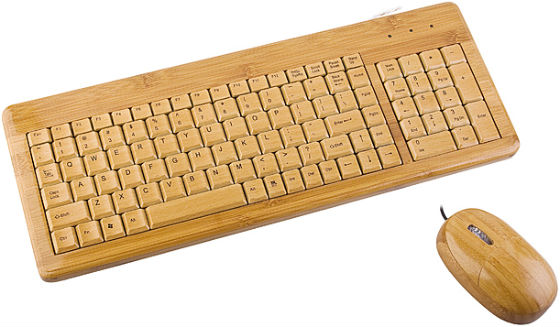
There is a downside to using renewable materials as well, as I always say, using any resource in excess and over consumption is never earth friendly..:)..Be wise choose well and be a minimalist!..Frugality is definitely eco-freindly
What would your garden grow
>> Thursday, 23 June 2011
Be it a tiny balcony, a backyard or a huge farm, whatever your space, what would your garden grow
Edibles??

source: inhabitat
or go floral

backyardnature(.)com
let me know ur thoughts as to why you chose either one of them
Read more...
Beyond Plastic Bags ~ a thought about our clothes
>> Sunday, 12 June 2011
While the crusade is on about plastic bags and other non bio degradables around us, one most important thing we forget about is the footprint of our clothes. I had this post in mind for a really long time now. However, I could not sum up my thoughts to speak about our clothing choices.
Even the green crusade brigade gives very little thought to the earth friendly-ness of the clothes worn. Little do we realize that all the polymer based products - Rayon, Nylon, Terricot, chiffon, synthetic crape (crepe), spandex, Acrylic etc are all non bio-degradable.

I go blank as to how this silent, most ignored and most dangerous plastic contribution may be stopped...If we all were to shift to cotton, hemp, jute or wool, the demand for these natural fiber would explode and lead to issues associated with over consumption and over production, processing and what not...I would appreciate your thoughts.
Note: And another point to note here is that routing non biodegradable junk/garbage to landfill is not a sensible solution. It is as bad as dumping our trash into the nearest water source (lakes, rivers, oceans). We need to understand the impact of leeching, plastic breakdown and the resulting impact on the fertility of the land (the landfill and a few kilometers around it), safety of water sources (running and ground), and the air near the landfill.
Happening Now ~ Green Week Conference in Brussels
>> Thursday, 26 May 2011
If you are anywhere close..make sure to attend

Want to know more...hop over to Environment/greenweek/
Read more...
Repurposed and Upcycled ~ Car tires
>> Thursday, 19 May 2011
I came across a Melbourne, Australia based company, called Ruba Designs

Ruba designs upcycles used car tires into amazing designer table mats, desk mats and coasters. If we were to ignore the enery and effort which goes into this process, and the consequent recycling process footprint, this is a cool concept...a lot better than directing used rubber tires into landfill and also reducing the need to chop trees, produce more cotton, bamboo, jute etc or produce more plastic for mats and coasters.


all images courtesy: Ruba
The Placemats and coasters, which won’t bend out of shape, are warm and inviting to touch, waterproof, heat resistant, dishwasher safe, and non-slip. They are available in 6 different designs to cater for different tastes. Also included in the collection are 4 styles of mouse pads and 3 styles of desk sets for the office. Ruba designers Sonia Attard and Lisa Vincitorio share their views in an interview on a fellow Green blog >>Link
If you are interested in updates about Ruba and its products...do click on their Facebook LIKE button :)..cheers to more such ventures..yay!!
Read more...
Subscribe to:
Posts (Atom)